Spring has me green with envy

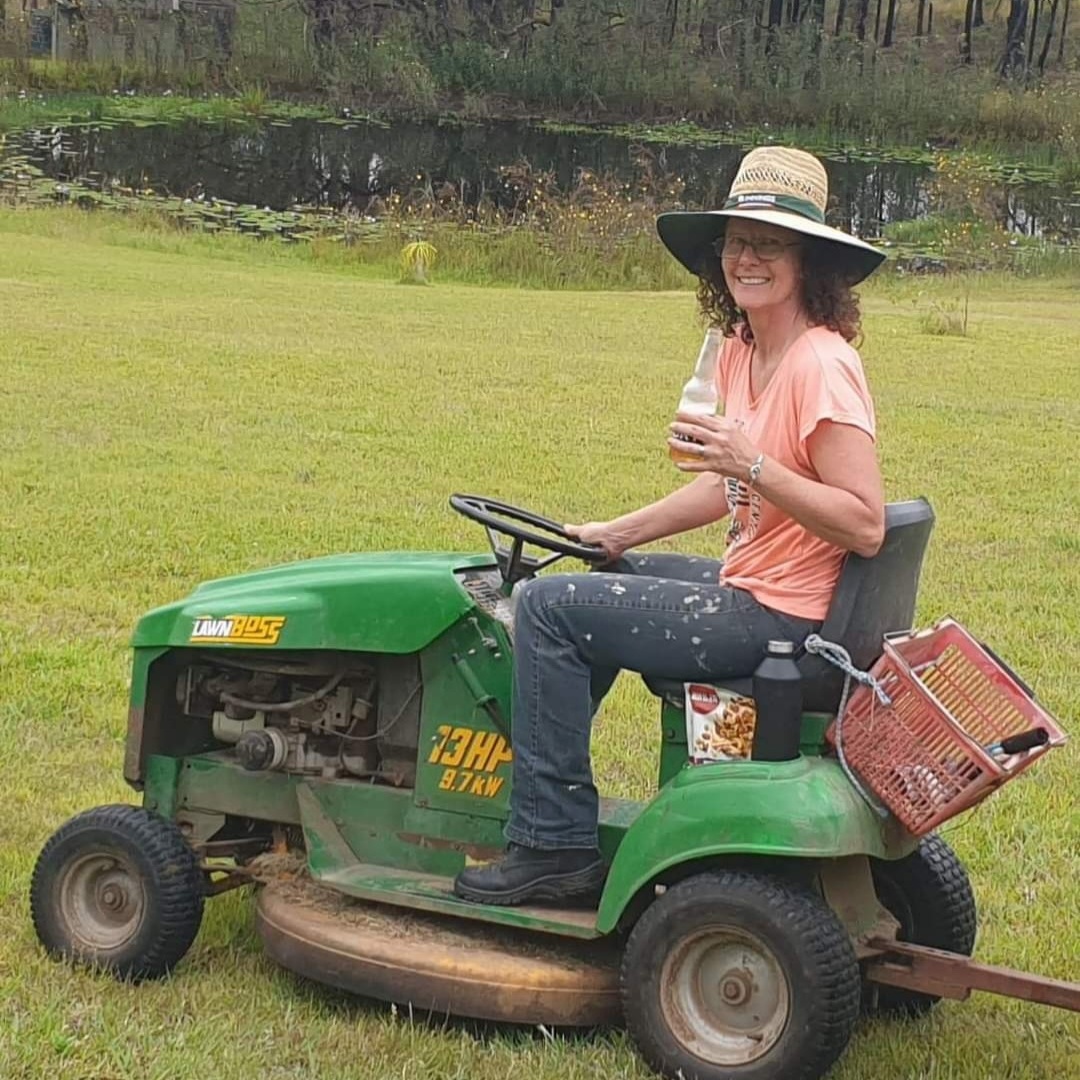
The Spring dawn of gentle sunrise and birdsong was torn apart by duelling internal combustion engines. The neighbours and I, ride-on mowers revving, trying to tame lawns and paddocks before a week of predicted rain.

If it was a ride-on mower duel, our neighbours would have won the morning, with their top-of-the-range, low centre-of-gravity, turn-on-a-tussock, purring machine. A far-flung second was me, astride our ancient, fume-belching, muffler-missing dinosaur. One of my legs held akimbo for balance on tippy slopes, one hand on the wheel and the other holding myself in position. A cramp in my toe from stretching to reach the distant pedal, because the seat’s rusted in position as far back as possible due to years of long-legged men driving in circles.

I may have a mild case of Lawn Mower Envy. An emotion I’d never felt, or even knew existed, before our tree-change to the country.

Hubby may suffer Lawn Mower Envy more seriously than me – he’s the one who spends hours on maintenance. Keeping our mowers moving – forwards. I’ve been instructed to limit engaging reverse as it creates wear on one of the belts, and the clutch.

I’m grateful our mower has a drink holder. Cheers to the person who first thought of including that. Ours usually holds a beer, but this morning, it’s coffee. It is only 7am. Our neighbours’ mower probably has a drinks holder too, even an insulated lunch chiller. Apparently, the expensive ones do.

Our main mower is Coxie, the Lawn Boss. He came with the property. He’s a long-time hard-worker, overdue for retirement. Yet he still battles through most of our heavy mowing.

We recently bought another second-hand, though much newer, ride-on called Fergie. Fergie as in the tractor manufacturer, Massey Fergusson. We thought that would mean she’s tough and reliable. Perfect for taming our tufts. Alas, she spends a fair amount of time up on the repair ramps in the shed, receiving Hubby’s ministrations.

Fergie may be much younger, shiny red, with a bigger motor, twin blades and a wider cut, but something to do with her gearing means she shirks the heavy work. The heavy work is along the back boundary where the tussocks are toughest, thickly interspersed with stiff-stemmed weeds that relentlessly march in from the poorly maintained adjoining property.

Today, with Hubby in the seat, heading towards the back boundary, Fergie blew a belt. (I promise I haven’t been overly engaging her reverse.) Fergie was left immobilised between the mango trees at the bottom of the slope.

The only solution was to hope Coxie could tow Fergie home. Poor, ancient Coxie – wheels spinning, Hubby and I pushing. All three of us groaning. But we managed. We dragged Fergie up the hill and back to the shed for her next round of coddling.

I don’t know if the neighbours saw any of that, or if they even knew they and I were having a lawn-mower duel.

Perhaps they can’t hear me over the classical music playing through their headphones, as they sip champagne from their drinks holder, and nibble chilled canapes from their on-board insulated lunch box.
Winter is when I say it is

 ‘Winter doesn’t start on the first of June. It starts when I say it does’, said Mother Nature, as she handed down the coldest May on Australian record.

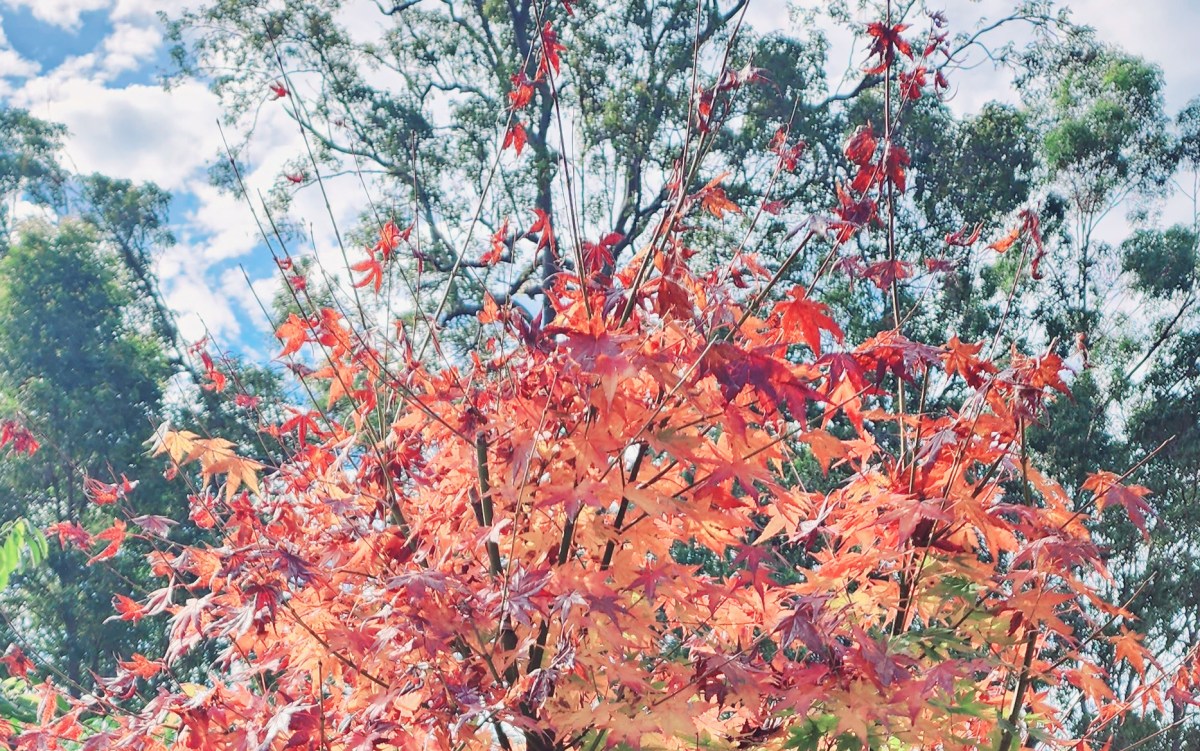
Now it’s July – midwinter. The magnolia tree by the back deck is completely bare of leaves and in its dormant state. The tree had been showing me for many weeks that this year, winter was coming early. Yet I remember standing in the hot sun, looking at its yellowing foliage and wondering if it needed more nitrogen. I’m a long way from being in touch with nature’s cycles.

If I’d observed the tree more closely, I’d have known a cold snap was coming. The hints to buy firewood, unpack ugg boots and winter clothes were missed. Are there other tasks we should have completed on the property before winter? Pruning, mulching, fertilising? Are the mango, macadamia, custard apple, fig, orange, loquat and pomegranate trees calling for something we’ve neglected to provide? Hopefully they’ll all survive another season as we learn to fall in step with their needs.

Connecting with the seasons is one of the reasons I moved to the country. To know a small parcel of earth. To leave that patch healthier than when we started – more able to sustain us and provide habitat for wildlife. To give back in a small way to Mother Nature.

It’s our second winter and I’m noticing similarities with last year – my start to understanding the seasons.

The raucous screech of the yellow-tail black cockatoos is less frequent – they’ve depleted the casuarina (she oak) cones down in the gully behind the back fence, and our neighbour’s supply of macadamia nuts. I love these majestic birds and we’ll definitely plant more food sources for them in years to come.

There was koala scat under the trees near the front gate. It’s not yet their mating season and without hearing their guttural, rumbling brays l forget they may be here year-round.

Like last winter, half-eaten figs scatter the ground, suitable only for composting. The king parrots get to the fruit long before us – I see them feasting from the loungeroom window. We’ll never score more than a couple of the juicy delights, but the parrots are beautiful. Loosing fruit to wildlife is known as ‘Bush Tax’, and like making payments to the Australian Taxation Office, there’s an inevitable contribution.

In the bottom garden the sweet potato vines (yams) are dying back and its nearly time to pull the tubers. For the second year, this will be a major winter harvest for us, along with citrus. Both the Valencia and Naval oranges are ready for picking – two more trees that luckily thrive on neglect.

Starting a gardening diary might help me understand the cycles – what’s planted where and harvested when. Year-to-year this would just be a guide though, as Mother Nature’s sequences don’t always fit neatly into the months allocated to seasons.

My permaculture teacher suggested tuning into seasonal changes, rather than gardening by calendar. He starts each day just wandering around his property, observing. He listens to Mother Nature’s whispers.

Even though it’s mid-winter, today on the afternoon breeze a sweet breath of Spring brushed my cheek. The idea of sipping cocktails during a warm sunset, rather than cosying near the fire, seems a pleasant possibility. Is this the first indication of the next season, an early Spring?

But before cocktails and warm afternoons, there’s lots of work needed to ready the garden for planting next season’s beans, corn, potatoes, pumpkin, tomatoes and zucchini.

I need to be ready because spring may not arrive on the first of September. Spring will be here when Mother Nature says it is.

Appreciation art Australia Beach Birds Bushfire christmas cooking Country life Family food Friends full-moon Garden GardenBirds Garden birds Gardening Happiness Health holiday holidays Home Life lifestyle Mindfulness Monthly journal moon Moving house Moving to the country Nature New home Permaculture Personal development spirituality Sustainability traditions travel Treechange Wildlife Witch WordlessWednesday Writing

The Australia Day outhouse

For future Australia Days, I have elaborate plans for a composting toilet, together with reed beds to filter greywater into an ideal frog habitat. Unfortunately, for this year we still had our single antiquated bathroom with an ancient, undersized septic system, supplied with water from just one rainwater tank.

These are the realities of our new country lifestyle. When it rains heavily, we’ll be cut off from town; when it doesn’t rain, we’ll need tankerloads of water delivered. When we flush the toilet too often, the septic overflows as the water supply dwindles.

Having family and friends to stay, therefore, has its challenges. Which, as it turns out, can become opportunities.

Back in November 2021, our Introduction to Permaculture course began with the usual housekeeping run-through: emergency evacuation procedures, break times, and of course, the location of the toilet. Ladies around to the left, men out the back to the Gentlemen’s Pissatorium. Sorry, the what?

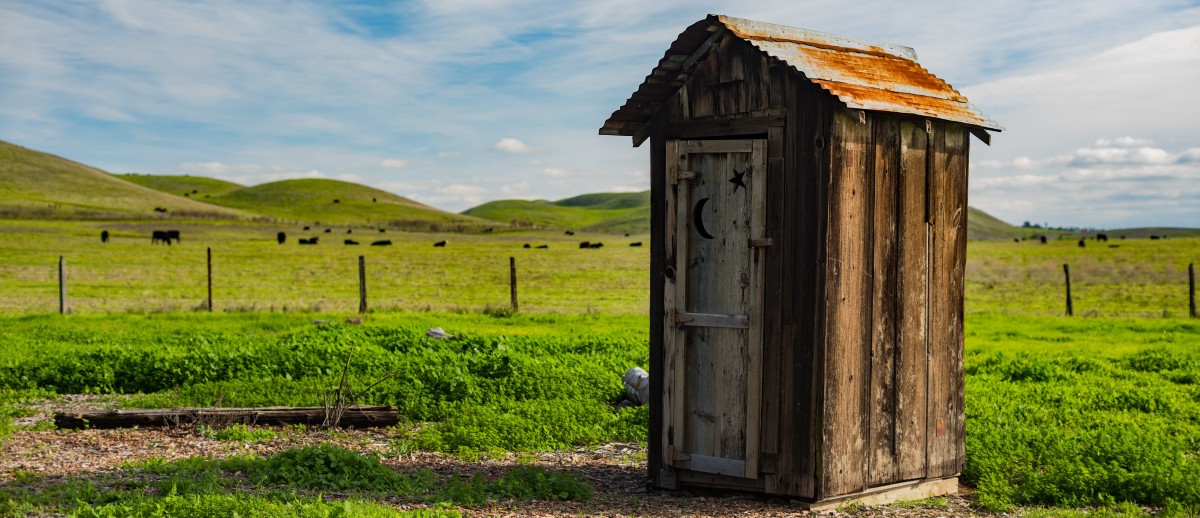
The Pissatorium. As it turns out, it’s a strawbale on the ground, semi-enclosed in sheets of corrugated iron wired to star pickets. At the end of each weekend, the semi-sodden straw is forked as nutrient-rich mulch straight into the soil to compost. We spent five minutes laughing over the predictable jokes about whether women also use the Pissatorium, but as permaculture students, we all agreed this was a great way to return both moisture and nitrogen to the soil.

In the December lead-up to family and friends staying for Christmas, my mind returned to the problem of our tiny septic system and single water tank. I pictured us all on the back deck, drinking Corona with lime (from our orchard no less) … and so the opportunity to return moisture and nutrients to the soil …

We already had an unused three-walled outhouse. Shaded by mango trees, a respectable distance from the back deck, it would be ideal. All we needed was an absorbent bale of something to place on the floor.

So on busy Christmas Eve I drove, part of a slow-moving procession of dusty farm vehicles, through to the loading section of the local drive-through produce store. I popped open the canopy on the back of the ute and was soon approached by an older man in faded jeans and a shirt in the produce store’s branded colours.

‘I’d like two bales of something absorbent I can use as garden mulch’, I began.

‘Lucerne hay is high in nutrients and good for the soil, but it’s more expensive. Bales of silage are cheaper.’

‘Does the silage have weed seeds in it? We already have enough weeds in the garden.’

‘Yes, it will probably have seeds in it. Sugarcane mulch is your best bet.’

‘Sugarcane is wrapped in plastic, isn’t it? I wanted something that stays together in a bale.’

‘Ahh, why do you need it to stay together in a bale If you want to spread it around as mulch?’

I glanced at the vehicles queuing behind in the drive through. Barely patient drivers wanting to buy food for their working dogs, worming paste for their livestock, new gum boots, or whatever else brought them to the produce store on Christmas Eve.

I decided the salesperson, with his kindly but now slightly confused face, looked like a salt-of-the-earth farmer-type himself, accustomed to the practicalities of country living.

‘Ok, I’ll tell you,’ I began. ‘I’m building a Gentlemen’s Pissatorium. We have people coming for Christmas, the small septic system backs up and we only have one water tank.’

Like a true pro, he showed no surprise at all, going straight into professional problem-solving mode.

‘Well, you could use the sugarcane mulch, you just need to cut one panel open for the top.’

And it worked.

Now, when friends and family come to stay, an introductory tour of our tiny farm includes the vege patch, dam, orchard, and the Gentlemen’s Pissatorium. Naturally, this is followed by the predictable jokes about whether women also use it.

The banter reminded me of my visit to Europe in my early twenties, when I encountered (from the outside), my first public pissoir. In the chill of winter it looked a breezy affair, with open panels along the top and bottom. There was no door, but the spiral-shaped entrance gave a modicum of privacy, although the occupants legs were visible from the knees down. My boyfriend and I had been out to dinner, then a walk, taking the scenic route back to our hotel. We happened upon a pissoir at a very timely time – for him.

I scouted behind the small building, looking for the cubical for women. There wasn’t one.

‘But I really need to go too,’ I said. ‘Where’s the girls’ pissoir?’

There wasn’t one.

In writing this post I needed to google ‘pissoir’ because I didn’t know if it was spelt with one ‘s’ or two. In doing so I learnt that the earliest pissoirs, ironically, were simply hay bales placed in discrete corners of European villages and markets. The bales were then used as mulch on fruit trees. I also learnt that controversy now rages over the few modern (with plumbing so they actually flush) pissoirs still in existence, due to the perceived sexism. Women are asking county councils why men are provided with pissoirs, while they are expected to just ‘hold on’.

Here in Australia it’s now Australia Day and our Gentlemen’s Pissatorium is on its third bale. After a few weeks of use, it takes two of us to lift out the bale to be replaced, but the sugarcane absorbs all the liquid and odour. We collect valuable nitrogen, among other trace elements, while saving four litres of water for every toilet flush.

In the future, our fruit trees will thank us. They’ll produce many limes, some of which will be sliced and placed in bottles of Corona, consumed on the back deck, a respectable walk from the Gentlemen’s Pissatorium.

And so, natures cycle continues its flow.