Cohabitating with nature

After my panicked phone call, the snake-catcher turned up – in shorts and thongs.

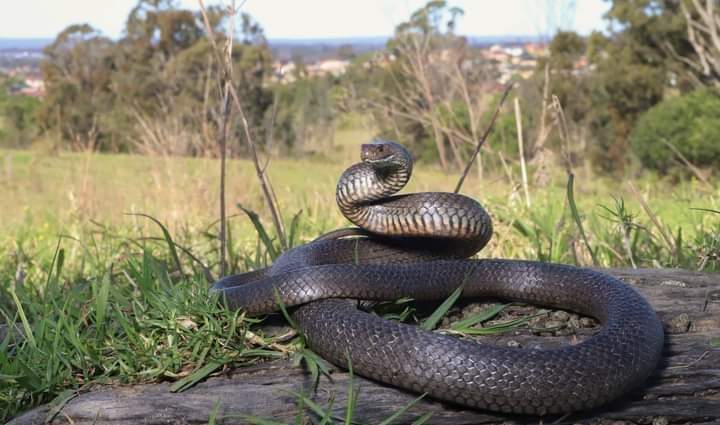
“I thought it would be a tree snake,” he said, looking at the photo I’d snapped of its disappearing tail an hour earlier – after it had slithered past my bare feet. “But that’s an Eastern Brown. I’ve never seen one around here.”

I checked in with my nearest neighbour. “Oh, really?” she said. “An Eastern Brown? I don’t remember the last time we saw one of those.”

Eastern Browns are the second deadliest snake in the world. I hope it’s gone from beneath my back stairs.

“The only way to know for sure it’s gone is to pull apart the whole staircase,” the snake-catcher said, helpfully.

That would be a full-day’s work. Plus, as Hubby estimated, three more days to put the staircase back together.

“You can live with a snake around,” said the snake catcher, “just be careful where you put your feet.”

A friend asked that night if I’d totally freaked out. I hadn’t, not immediately. Time had stood still. Then, after both the long, silent moment, and the long, silent snake, had passed me by, I’d screamed. Then, gasping, and with shaking fingers, frantically and repeatedly tried to send a text off to hubby who was slashing grass down by the dam.

I’d read that if a snake approaches you, stand still and let it pass. Ironically, in my frozen panic I’d done just that. The snake had flicked its tongue, tasted my presence in the air, then languorously turned away. Its scaly shimmer slipped soundlessly beneath the wooden step, right by my feet. I finally breathed again, into the silence. Silence, like nothing out of the ordinary had just happened.

“What are you going to do now? Do you regret moving to the bush?” My friend questioned that night, perhaps horrified and fascinated because she, too, had recently moved from the city.

“Well, I wish my husband would keep the back door closed!”

Hubby had tried to soothe me, saying snakes don’t go inside.

They bloody might. Why wouldn’t they, when it’s cool and quiet in the middle of the day. When we’re using the mower on the back lawn, stamping around and dragging pot plants about?

My husband’s behaviour didn’t change at all. Still walking around in bare feet. Me, in comparison, for the first whole week ‘post-snake’, chose knee-high gumboots to accessorise my usual sarong when venturing down the stairs to the spa at night. I also spent three days stomping up and down the stairs in work boots and jeans, generally creating as much ruckus as possible.

A week later and we hadn’t seen the snake again. I sought the advice of the experts on the Australian Snake Identification, Education + Advocacy Facebook group.

“Is it likely the snake has moved on?”

“To be sure, you should replace the wooden deck and staircase with concrete,” was the advice. “You have chickens which attract rodents, which attract snakes. You have water, frogs, and a safe space for snakes to hide and hunt. But remember, Eastern Browns don’t like movement. They’ll get out of your way before you even know they’re there. Just look down before you step down. It is possible to cohabitate with them.”

Cohabitate with the second deadliest snake in the world?

Remodelling the back deck and stairs IS on the renovation list – somewhere between the priorities of fencing, more water tanks, retaining walls and building another shed.

I now know snakes are definitely around, instead of possibly around. I’ve also learnt they don’t chase you. Just look out for them, and don’t step on them.

Life continued for another week.

I now look down before I step down. I’ve calmed down. I’ve reverted to wearing thongs outside.

Then, yesterday, as I looked down, a scaly scurry. Something half-seen slipped from the sunny step beneath my feet. A huge blue tongue lizard.

Another question for the Facebook snake advocacy group.

“There’s a big blue tongue living right where the Eastern Brown was. Does this mean the snake has moved on?”

“Possibly,” was the reply, “but not necessarily. Eastern Browns and Blue Tongues can cohabitate quite happily.”

I may be cohabitating with a snake. And a Blue Tongue.

Photo credit: Shane Walsh, who takes wonderful photos and advocates for cohabitating with wildlife.

Notes:

Even if we are cohabitating, we are never going to be friends. There’s a snake bite kit handy, just in case.

For international readers, ‘thongs’ in Australia generally means ‘flip flops’.
Winter is when I say it is

 ‘Winter doesn’t start on the first of June. It starts when I say it does’, said Mother Nature, as she handed down the coldest May on Australian record.

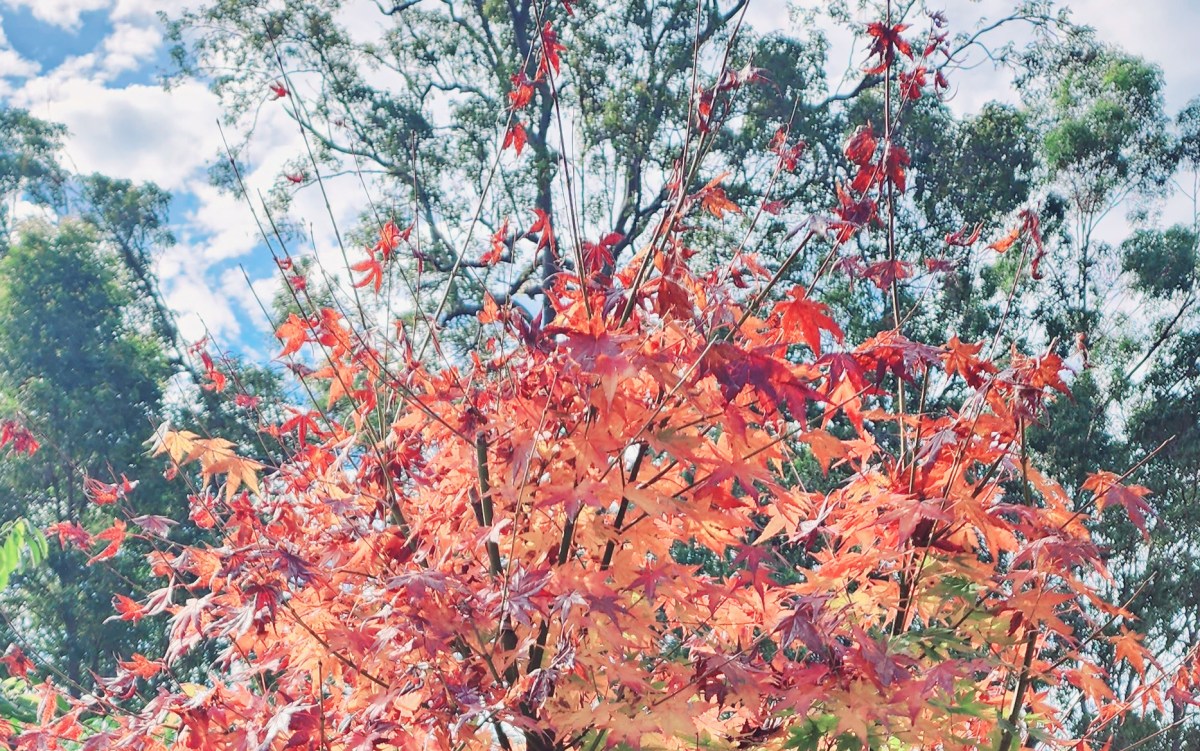
Now it’s July – midwinter. The magnolia tree by the back deck is completely bare of leaves and in its dormant state. The tree had been showing me for many weeks that this year, winter was coming early. Yet I remember standing in the hot sun, looking at its yellowing foliage and wondering if it needed more nitrogen. I’m a long way from being in touch with nature’s cycles.

If I’d observed the tree more closely, I’d have known a cold snap was coming. The hints to buy firewood, unpack ugg boots and winter clothes were missed. Are there other tasks we should have completed on the property before winter? Pruning, mulching, fertilising? Are the mango, macadamia, custard apple, fig, orange, loquat and pomegranate trees calling for something we’ve neglected to provide? Hopefully they’ll all survive another season as we learn to fall in step with their needs.

Connecting with the seasons is one of the reasons I moved to the country. To know a small parcel of earth. To leave that patch healthier than when we started – more able to sustain us and provide habitat for wildlife. To give back in a small way to Mother Nature.

It’s our second winter and I’m noticing similarities with last year – my start to understanding the seasons.

The raucous screech of the yellow-tail black cockatoos is less frequent – they’ve depleted the casuarina (she oak) cones down in the gully behind the back fence, and our neighbour’s supply of macadamia nuts. I love these majestic birds and we’ll definitely plant more food sources for them in years to come.

There was koala scat under the trees near the front gate. It’s not yet their mating season and without hearing their guttural, rumbling brays l forget they may be here year-round.

Like last winter, half-eaten figs scatter the ground, suitable only for composting. The king parrots get to the fruit long before us – I see them feasting from the loungeroom window. We’ll never score more than a couple of the juicy delights, but the parrots are beautiful. Loosing fruit to wildlife is known as ‘Bush Tax’, and like making payments to the Australian Taxation Office, there’s an inevitable contribution.

In the bottom garden the sweet potato vines (yams) are dying back and its nearly time to pull the tubers. For the second year, this will be a major winter harvest for us, along with citrus. Both the Valencia and Naval oranges are ready for picking – two more trees that luckily thrive on neglect.

Starting a gardening diary might help me understand the cycles – what’s planted where and harvested when. Year-to-year this would just be a guide though, as Mother Nature’s sequences don’t always fit neatly into the months allocated to seasons.

My permaculture teacher suggested tuning into seasonal changes, rather than gardening by calendar. He starts each day just wandering around his property, observing. He listens to Mother Nature’s whispers.

Even though it’s mid-winter, today on the afternoon breeze a sweet breath of Spring brushed my cheek. The idea of sipping cocktails during a warm sunset, rather than cosying near the fire, seems a pleasant possibility. Is this the first indication of the next season, an early Spring?

But before cocktails and warm afternoons, there’s lots of work needed to ready the garden for planting next season’s beans, corn, potatoes, pumpkin, tomatoes and zucchini.

I need to be ready because spring may not arrive on the first of September. Spring will be here when Mother Nature says it is.

Appreciation art Australia Beach Birds Bushfire christmas cooking Country life Family food Friends full-moon Garden GardenBirds Garden birds Gardening Happiness Health holiday holidays Home Life lifestyle Mindfulness Monthly journal moon Moving house Moving to the country Nature New home Permaculture Personal development spirituality Sustainability traditions travel Treechange Wildlife Witch WordlessWednesday Writing

The Australia Day outhouse

For future Australia Days, I have elaborate plans for a composting toilet, together with reed beds to filter greywater into an ideal frog habitat. Unfortunately, for this year we still had our single antiquated bathroom with an ancient, undersized septic system, supplied with water from just one rainwater tank.

These are the realities of our new country lifestyle. When it rains heavily, we’ll be cut off from town; when it doesn’t rain, we’ll need tankerloads of water delivered. When we flush the toilet too often, the septic overflows as the water supply dwindles.

Having family and friends to stay, therefore, has its challenges. Which, as it turns out, can become opportunities.

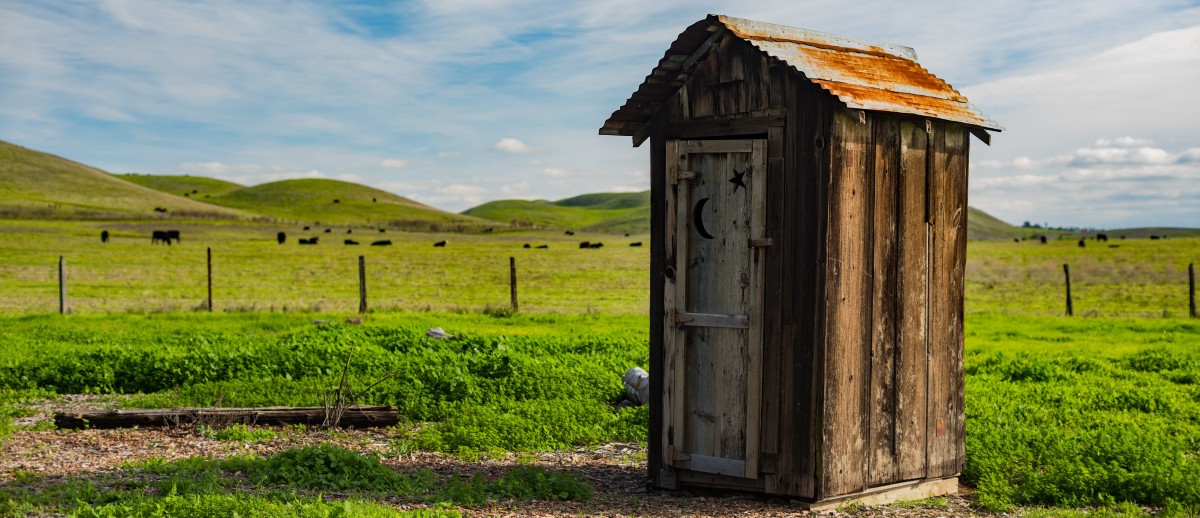
Back in November 2021, our Introduction to Permaculture course began with the usual housekeeping run-through: emergency evacuation procedures, break times, and of course, the location of the toilet. Ladies around to the left, men out the back to the Gentlemen’s Pissatorium. Sorry, the what?

The Pissatorium. As it turns out, it’s a strawbale on the ground, semi-enclosed in sheets of corrugated iron wired to star pickets. At the end of each weekend, the semi-sodden straw is forked as nutrient-rich mulch straight into the soil to compost. We spent five minutes laughing over the predictable jokes about whether women also use the Pissatorium, but as permaculture students, we all agreed this was a great way to return both moisture and nitrogen to the soil.

In the December lead-up to family and friends staying for Christmas, my mind returned to the problem of our tiny septic system and single water tank. I pictured us all on the back deck, drinking Corona with lime (from our orchard no less) … and so the opportunity to return moisture and nutrients to the soil …

We already had an unused three-walled outhouse. Shaded by mango trees, a respectable distance from the back deck, it would be ideal. All we needed was an absorbent bale of something to place on the floor.

So on busy Christmas Eve I drove, part of a slow-moving procession of dusty farm vehicles, through to the loading section of the local drive-through produce store. I popped open the canopy on the back of the ute and was soon approached by an older man in faded jeans and a shirt in the produce store’s branded colours.

‘I’d like two bales of something absorbent I can use as garden mulch’, I began.

‘Lucerne hay is high in nutrients and good for the soil, but it’s more expensive. Bales of silage are cheaper.’

‘Does the silage have weed seeds in it? We already have enough weeds in the garden.’

‘Yes, it will probably have seeds in it. Sugarcane mulch is your best bet.’

‘Sugarcane is wrapped in plastic, isn’t it? I wanted something that stays together in a bale.’

‘Ahh, why do you need it to stay together in a bale If you want to spread it around as mulch?’

I glanced at the vehicles queuing behind in the drive through. Barely patient drivers wanting to buy food for their working dogs, worming paste for their livestock, new gum boots, or whatever else brought them to the produce store on Christmas Eve.

I decided the salesperson, with his kindly but now slightly confused face, looked like a salt-of-the-earth farmer-type himself, accustomed to the practicalities of country living.

‘Ok, I’ll tell you,’ I began. ‘I’m building a Gentlemen’s Pissatorium. We have people coming for Christmas, the small septic system backs up and we only have one water tank.’

Like a true pro, he showed no surprise at all, going straight into professional problem-solving mode.

‘Well, you could use the sugarcane mulch, you just need to cut one panel open for the top.’

And it worked.

Now, when friends and family come to stay, an introductory tour of our tiny farm includes the vege patch, dam, orchard, and the Gentlemen’s Pissatorium. Naturally, this is followed by the predictable jokes about whether women also use it.

The banter reminded me of my visit to Europe in my early twenties, when I encountered (from the outside), my first public pissoir. In the chill of winter it looked a breezy affair, with open panels along the top and bottom. There was no door, but the spiral-shaped entrance gave a modicum of privacy, although the occupants legs were visible from the knees down. My boyfriend and I had been out to dinner, then a walk, taking the scenic route back to our hotel. We happened upon a pissoir at a very timely time – for him.

I scouted behind the small building, looking for the cubical for women. There wasn’t one.

‘But I really need to go too,’ I said. ‘Where’s the girls’ pissoir?’

There wasn’t one.

In writing this post I needed to google ‘pissoir’ because I didn’t know if it was spelt with one ‘s’ or two. In doing so I learnt that the earliest pissoirs, ironically, were simply hay bales placed in discrete corners of European villages and markets. The bales were then used as mulch on fruit trees. I also learnt that controversy now rages over the few modern (with plumbing so they actually flush) pissoirs still in existence, due to the perceived sexism. Women are asking county councils why men are provided with pissoirs, while they are expected to just ‘hold on’.

Here in Australia it’s now Australia Day and our Gentlemen’s Pissatorium is on its third bale. After a few weeks of use, it takes two of us to lift out the bale to be replaced, but the sugarcane absorbs all the liquid and odour. We collect valuable nitrogen, among other trace elements, while saving four litres of water for every toilet flush.

In the future, our fruit trees will thank us. They’ll produce many limes, some of which will be sliced and placed in bottles of Corona, consumed on the back deck, a respectable walk from the Gentlemen’s Pissatorium.

And so, natures cycle continues its flow.

The season of green and black

‘The fire only made it as far as your boundary,’ the real estate agent confirmed, indicating some fence posts with blackened crowns. She painted pictures in our minds of our prospective new home being a safe haven, an untouched oasis.

Not fully trusting her vested interests, we looked closer and found charring on trees up the gully, above the dam and nearer to the house. We learnt a home further along the road was lost in the Black Summer fires of 2019/20, which devastated almost the whole of the Australian East Coast.

But we bought the property and made the move to the country, making an informed choice, aware of the risk of a future fire. The risk is not particular to this property, but almost any. Here we know some of the surrounding land is cleared for grazing, most of the closest trees between us and the state forest are in our orchard and probably less predisposed to fire than eucalypts. We’ll buy a slasher to keep the grass short. We’ll put in more water tanks and pumps. A friend admitted that after those fires he’s now obsessed with pumps and backup pumps, generators and backup generators.

During our first day at our new house, we received our first mail delivery – from the NSW Rural Fire Service. Welcome, and a reminder to get bushfire ready. Welcome to the country, and the responsibilities of owning a property.

What it was like, back on that day of the fire, here on our not-so-untouched haven and oasis? Were the previous owners bushfire ready? They left us two pumps in separate pump houses down at the dam. The smaller one irrigates the orchard, the larger supplies flow to the fat fire hose, coiled and mounted in a shiny red casing close to the house. When we started this pump, water sprayed in an arc halfway up the hill toward the house, where the plastic transfer pipe had melted in the fire. At the very time it was needed, the fire hose was rendered useless by the fire itself.

If you’ve driven any part of the Australian East Coast over the past two years you may have seen land struggling to heal. Much of the bushland I’ve seen is fire-affected, but with some new green growth sprouting from the charred black remains. It’s the season of green and black. But where the fires burned too hot, trees are faded to grey skeletons, the ghosts of gums that will not recover.

Communities also are struggling to heal. Local councils still employ coordinators to assist recovering residents and communities, and seasonal workers camp at rural showgrounds as contractors to replace fencing for property owners with disaster recovery funding.

During that terrible firey season, 5.5 million hectares of land was devastated, 2,448 homes destroyed, and 26 lives lost. Many native plant and animal species are now extinct or endangered. Cossetted in my city home I wanted to do something. Thoughts of injured and suffering kangaroos, koalas, wombats, and birds plagued my nights. Like many people, I sewed ‘koala mittens’ and ‘batwraps’, donated money to WIRES and community fundraisers.

I’d like to think those fires were an anomaly. I’d like to think it will take years for the regrowth to sustain another large fire. I’d like to think that we’ve had recent rain and there’s no immediate danger. That we can get on with fun and exciting activities like house improvements, establishing a vegie garden, planting a food forest, buying chickens and maybe goats; instead of preparing for a potential bushfire. But I know this thinking may mean we’re not bushfire ready when we need to be.

We need to replace the melted hose pipe and bury it deeper underground. We need to learn what the ‘SWS’ (Static Water Supply) sign affixed to our front gate means – presumably, we need to provide easy access for an empty fire truck thirsty for our water tanks and dam. If a fire does come, where will we move our vehicles to? Which of us will look after our pets? How and when will we decide whether to defend our home or evacuate?

I’m here to live closer to nature, more in tune with her cycles. Summer and bushfire season is part of that cycle. It’s summer now, but we’ve had lots of rain. The dams and tanks are overflowing, it’s lush and verdant. Now is the season for appreciating the rich colours, the abundant growth. The season of green (and black). But this is Australia, so now is also the time to prepare for future seasons.

Note: photo is not our property, thank goodness.