
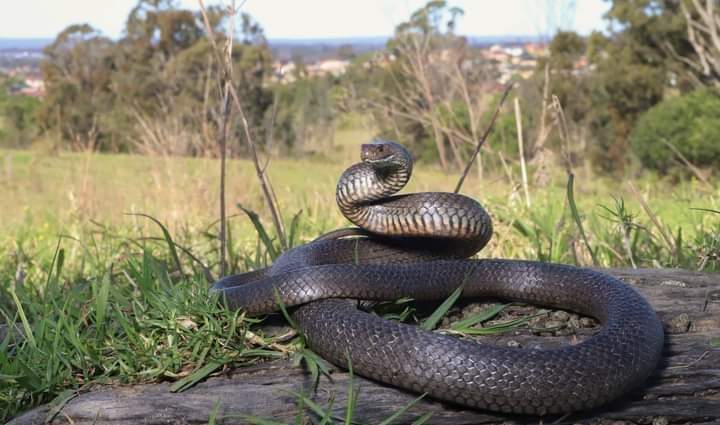
After my panicked phone call, the snake-catcher turned up – in shorts and thongs.
“I thought it would be a tree snake,” he said, looking at the photo I’d snapped of its disappearing tail an hour earlier – after it had slithered past my bare feet. “But that’s an Eastern Brown. I’ve never seen one around here.”
I checked in with my nearest neighbour. “Oh, really?” she said. “An Eastern Brown? I don’t remember the last time we saw one of those.”
Eastern Browns are the second deadliest snake in the world. I hope it’s gone from beneath my back stairs.
“The only way to know for sure it’s gone is to pull apart the whole staircase,” the snake-catcher said, helpfully.
That would be a full-day’s work. Plus, as Hubby estimated, three more days to put the staircase back together.
“You can live with a snake around,” said the snake catcher, “just be careful where you put your feet.”
A friend asked that night if I’d totally freaked out. I hadn’t, not immediately. Time had stood still. Then, after both the long, silent moment, and the long, silent snake, had passed me by, I’d screamed. Then, gasping, and with shaking fingers, frantically and repeatedly tried to send a text off to hubby who was slashing grass down by the dam.
I’d read that if a snake approaches you, stand still and let it pass. Ironically, in my frozen panic I’d done just that. The snake had flicked its tongue, tasted my presence in the air, then languorously turned away. Its scaly shimmer slipped soundlessly beneath the wooden step, right by my feet. I finally breathed again, into the silence. Silence, like nothing out of the ordinary had just happened.
“What are you going to do now? Do you regret moving to the bush?” My friend questioned that night, perhaps horrified and fascinated because she, too, had recently moved from the city.
“Well, I wish my husband would keep the back door closed!”
Hubby had tried to soothe me, saying snakes don’t go inside.
They bloody might. Why wouldn’t they, when it’s cool and quiet in the middle of the day. When we’re using the mower on the back lawn, stamping around and dragging pot plants about?
My husband’s behaviour didn’t change at all. Still walking around in bare feet. Me, in comparison, for the first whole week ‘post-snake’, chose knee-high gumboots to accessorise my usual sarong when venturing down the stairs to the spa at night. I also spent three days stomping up and down the stairs in work boots and jeans, generally creating as much ruckus as possible.
A week later and we hadn’t seen the snake again. I sought the advice of the experts on the Australian Snake Identification, Education + Advocacy Facebook group.
“Is it likely the snake has moved on?”
“To be sure, you should replace the wooden deck and staircase with concrete,” was the advice. “You have chickens which attract rodents, which attract snakes. You have water, frogs, and a safe space for snakes to hide and hunt. But remember, Eastern Browns don’t like movement. They’ll get out of your way before you even know they’re there. Just look down before you step down. It is possible to cohabitate with them.”
Cohabitate with the second deadliest snake in the world?
Remodelling the back deck and stairs IS on the renovation list – somewhere between the priorities of fencing, more water tanks, retaining walls and building another shed.
I now know snakes are definitely around, instead of possibly around. I’ve also learnt they don’t chase you. Just look out for them, and don’t step on them.
Life continued for another week.
I now look down before I step down. I’ve calmed down. I’ve reverted to wearing thongs outside.
Then, yesterday, as I looked down, a scaly scurry. Something half-seen slipped from the sunny step beneath my feet. A huge blue tongue lizard.
Another question for the Facebook snake advocacy group.
“There’s a big blue tongue living right where the Eastern Brown was. Does this mean the snake has moved on?”
“Possibly,” was the reply, “but not necessarily. Eastern Browns and Blue Tongues can cohabitate quite happily.”
I may be cohabitating with a snake. And a Blue Tongue.
Photo credit: Shane Walsh, who takes wonderful photos and advocates for cohabitating with wildlife.
Notes:
Even if we are cohabitating, we are never going to be friends. There’s a snake bite kit handy, just in case.
For international readers, ‘thongs’ in Australia generally means ‘flip flops’.
